Good question.
I can’t be sure, but I’m reasonably certain it was Guy Kawasaki who suggested dressing one level of formality above your audience. The need for being more formal is to give yourself a level of authority, but being only one level (no three piece suits if your audience is in jeans and Tshirts) means that you’re not alienating yourself from them.
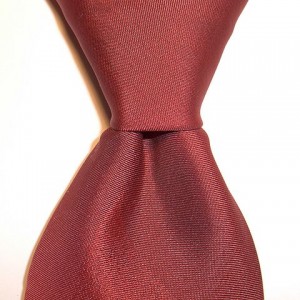
Red tie. (Credit Wikipedia)
Personally, I’d suggest arriving in two levels of formality above your audience. This is simply in case you mis-guess how formal your audience is. If they’re more formal than you expect, you’re covered and if they’re less formal than you expect you can easily and quickly come down a level of formality – certainly you can come down a level of formality much more quickly than you can go up one if you’ve not got the right clothing with you.
For example, I can take off a tie in a matter of seconds with not fuss, but I can’t magic a tie out of no-where if I’m not carrying one… and even if I am, it takes me more time and fuss to get it out, put it on and tie it.
Similarly taking a jacket off is less fuss than putting one on… you get the idea.
Mind you, there’s an obvious limit to this advice! If your audience is in formal suits and the ladies’ equivalent, you can’t go two levels above this – so just use some common sense! Having said that, if they’re in a suit (or the female equivalent), you can still go one level up by wearing a really classy suit. (Trust me on this, I’ve got a suit in my wardrobe that rarely sees the light of day but when I wear it, I weaaarrrrr it.)
Another limit is if you’re presenting to people you know well. They’ll spot it if you’re trying to pull one over on them by wearing something smart if you’re the kind of person who wears jeans and a sloppy sweater all the time, usually. But even then, you can smarten up just a little bit – just not too much!
But what else dictates what you wear?
Well obviously there are cultural and social norms that you should stick to. If the group you’re talking to frowns on something, don’t wear it. Personally I find it rare that this kind of thing is an issue but it can’t hurt to ask before you speak. I find it pretty simple to just ask “What’s the audience dress code for this event?” (or words to that effect) and the information I get steers my choices.
Not that it steers it – it doesn’t dictate it. If I need to make a point, I’ll make a point. ;)
What about colour?
It’s a sweeping generalisation, but the darker you dress, the more formal you’ll seem.
And comfort?
This is a tricky one. Obviously, you’ll perform worse if you’re so un-comfortable in what you wear that it reduces your concentration on your topic, but my experience is that comfort is over-rated. What’s more important is confidence. You need (really, really need) to be confident in what you’re wearing. You need to be confident that you look good. I’m not saying you need to wear an Armani suit, just that you need to feel that what you’re wearing is ‘you’. If it isn’t your audience will spot it. If they spot it, they’ll realise you’re faking something.
And if you’re faking this, they’ll think, what else might you be faking? Your content, perhaps?
Brutal but (usually) true, sadly.
So to sum up?
Common sense trumps all – because as you might have realised by now, some of the guidelines for all of this might end up being contradictory. The only real ‘rule’ is to figure out what you’re trying to achieve and dress for that – don’t just dress without thought or without knowing what you’re trying to say. Even if you’re not ‘saying’ anything with how your dress, the audience will ‘hear’ something, so you need to make sure they hear what you’re intending. Presentations are about impact, not just content!


