A few days ago I posted a presentation tips tweet and – because of the 140 characters limit in twitter it was necessarily brief and terse. I’d intended it to be an invocation for presenters to treat their audiences with respect and remember that just because they (the audience) didn’t know something it didn’t mean that they (the audience) shouldn’t be treated with respect. It looked like this:
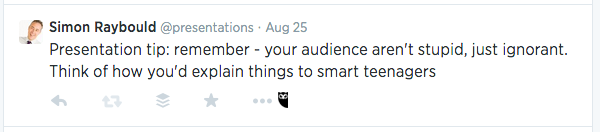
And a storm blew up in my face because of negative connotations of the word “ignorant”. In the end, I gained a few followers, had an interesting conversation and learned one new word – not bad for a chat I was having in a pub in Scotland on a free wifi! In the process, however, something interesting happened.
People found me guilty of doing things that, not only had I not done, but hadn’t been done by anyone (or at least not in the conversation)! So what was going on? Was someone sneaking in on my ID, writing things to get a response and then deleting them and logging off again before I noticed… repeatedly?
I’m going to assume it wasn’t that. Fair enough?
I think the solution was much more simple.
- Twitter doesn’t allow for subtle communication, which means a lot gets implied.
- Some things get inferred above and beyond to what was implied.
- Cultural difference mean that different things get inferred by people in different parts of the world and in different circumstances.
- People will infer what suits their view of the world, not necessarily anything to do with an objective view of the world.
- People will respond to you in the light of point four, irrespective of other people’s reality.
The last point is fair enough – after all, all of us can only ever respond to what we perceive. It would help, of course, if everyone’s realities were the same. Okay, the world would be boring as hell, but at least we’d stand more chance of not mis-understanding each other!
So how can we use this (blindingly obvious?!) revelation in presentations? Like this…
Ask yourself before you start to design your presentation what your audience already knows (or thinks, or believes). Challenge yourself to see the world from their eyes. Then stop and have a cup of tea and do that again, because no one ever manages to do it the first time. Get a friend to challenge you – every statement and assumption. (As an aside, see how long it takes you to get annoyed at them, even though they’re helping you.)
So much for the obvious.
Now onto something that takes a little more guts.
At the start of your presentation, challenge your audience’s assumptions, particularly those which you know (really? you know??!!) to be wrong.
Don’t spend a lot of time on it, but be clear what your assumptions are. Let’s take a silly example. Suppose your presentation is about why tall people are smarter (I’m exactly six feet tall, what do you think?). If there’s someone in your audience who knows that it’s not because they’re taller – it’s because they’ve got dark hair (I’m grey) and anyway, it’s people of average height that are smarter… well, you can see that they’re not going to listen to a word you say, no matter how interesting or compelling your evidence might be about the ‘why’ of things.
A simple statement at the start of your presentation will deal with that. “The research done by X, Y and Z established that taller people are, on average, smarter. I’m going to be looking at why that is.”
At the very worst, you’ve deflected your (presumably shorter) antagonists’ wrath towards X, Y and Z who did the offending research. If all else fails you can say something to the effect that you’re happy to discuss the research later, but for now, can we at least take it as a hypothetical “if tall people are smarter” or “assuming tall people are smarter” and move on for everyone else.
At best, you’ve reassured the sceptics that your assumptions have been validated. Obviously X, Y and Z need to be respected authorities on the subject of height-vs-smartness for this to work but if they’re not, you’d not be presenting your own findings in any case, would you?!
What’s the downside of starting a presentation with a few basic statements of “We believe”? To be honest, it’s the boredom factor. A list of assumptions isn’t the most fascinating start to a presentation – so I’ll deal with that problem next time.


1 Comment
Comments are closed.