I don’t suppose the lovely Beyonce goes on stage without rehearsing… oh no… but there’s some interesting stuff about how useful it is to practice, just here:
http://www.spring.org.uk/2014/07/the-10000-hours-myth-practice-predicts-only-12-of-performance.php
There are a lot of myths around making presentations and similar things. You’ve only got to look at the nonsense of Prof Mehrabian’s 7% to know that. One of the bigger ones, that’s been around for a while, is the idea that it takes 10,000 hours of practice to achieve ‘mastery’ of something and – according to some people putting in 10,000 hours will allow you to master anything.
Such as presenting.
Much of the idea (if not all) can be traced back to Malcolm Gladwell and his book “Outliers”. It’s important here to remember that Gladwell is a journalist, not a researcher, so perhaps we should forgive him for his over-simplifications. You can see a nice summary of his stuff at http://www.wisdomgroup.com/blog/10000-hours-of-practice/.
More recently however, psyblog (http://www.spring.org.uk/2014/07/the-10000-hours-myth-practice-predicts-only-12-of-performance.php) reports some meta research that tells a different story. (Meta-research puts lots of other bits of research together to look at the pattern, not just the individual outcomes of different experiments.) The abstract for the research itself is here: http://pss.sagepub.com/content/early/2014/06/30/0956797614535810
In short, the research suggests that practice is important (obviously) – but it’s not as important as some of the more extreme claims. The amount of ‘stuff explained’ by practice is different for different things, as you’d expect, with games top of the list. 26% of variance is associated with ‘deliberate practice for games’. Music follow closely at 21%. Sport is 18%.
Way down… way, way down, however, are education at 4% and a mere 1% for professions!
Yes, that’s right… for a mix of professional activities, how much you practice accounts for only 1% of the difference between the best people and those at the other end of the spectrum.
FLYS IN THE FACE OF WALT DISNEY’S APHORISM “IF YOU CAN DREAM IT, YOU CAN DO IT”
Think about that for a second and you realise that’s not the same as saying that only one percent of how good you are is explained by practice, but even so, it’s a starling small amount.
I’ve not yet had chance to read the full text of the research paper so I don’t know all the ins-and-outs, but I’m prepared to make a couple of guesses here. Firstly, there’s some variation around those figures, because everyone is different and those figures are averages.
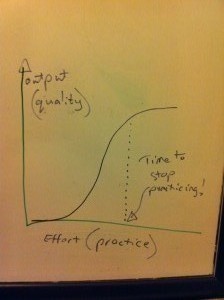
A sigmoid curve graph
Secondly, I’m going to stick my neck out and say there’s not a linear relationship between practice and performance. (A linear relationship is one where the two variables involved go up in such a way as to create a straight line on a graph.) Instead, I’ll bet there’s what scientists call a ‘sigmoid curve’ response. A sigmoid curve is commonly referred to as an S curve.
In other words, if you draw a graph of input (practice) against output (performance), you’ll start off not getting very much improvement for your effort – then things will fall into place a bit and for each bit of practice you do you’ll get quite a lot of improvement. Finally, diminishing marginal returns will set in and for each bit of extra practice you do, you’ll get a smaller and smaller amount of improvement.
Of course, I’m guessing at this point and it’s easy to imagine a set of sigmoid curves sitting on top of each other as you make a set of breakthroughs in your practice but you get the point – there’s no point in doing only a tiny bit of practice and there’s no point in doing a huuuuuge amount of practice.
Sure, the professionals amongst us should practice and practice and practice, but for the rest of us, those living in the normal world where presentations are a means to and end and now what we do for a living, there comes a point where the trade-off of time and effort for an improved quality of presentation isn’t worth it.
Oh.. wait… Stop! Please… just stop!
I can see it now… millions of people all over the planet using this as an excuse not to put the hours in preparing their presentations… that’s not what I mean… to late… they’ve stopped reading…


1 Comment
Comments are closed.